Well done, sir! I was so mad at the one I missed because I should have known better. Sigh. Next time I will be more careful. I like maps. I like to see how the landforms took shape, how water has carved into the earth, etc. Right now we are making our way through the series
Just bear in mind one of the definitions of a genius...
A genius is not someone who knows the answer, but someone who knows how to find/derive the answer.
Also remember that Geography begins with Location, then it becomes more involved. In fact, 25 years ago and more, Geography used to be divided into 5 Themes and they were presented in a popular atlas used in colleges. The themes?
Location
Place
Relationship Within Place: Human-Environmental Interaction
Movement
Region
I always maintained that the middle one... Relationship Within Place: Human-Environmental Interaction... is the very definition of Geography and in spite of some efforts by a select few college professors, no one could discredit the idea. Usually, they'd throw the concept of how it was done vis a vis 'spatial' arrangements.
I'd point out that fell under 'Region' as the core of Geography's 'spatial' study and region is a 'place,' where the human-environmental interaction (relationship), including movement, is what is studied. You see, one of the things I learned is that 'Region' is an amorphous construct; i.e., it all depends on how whomever wants to 'limit' the place.
The whole thing goes back to 1919 and The Circumference of Geography...
https://archive.org/details/jstor-207825/page/n1/mode/2upThe modern version looks more like this...
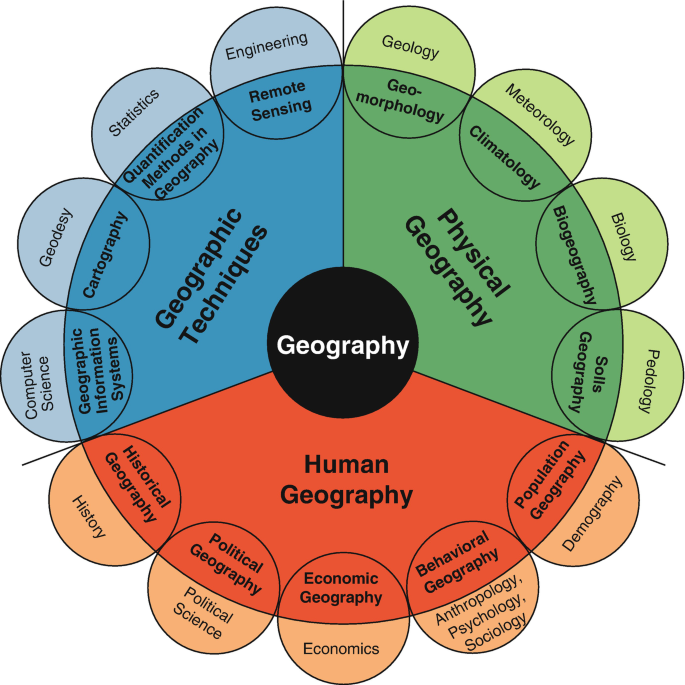
In short, Geography uses 'spatial' relationships as a context, but it is the study of human-environmental interaction which is the core of study.
Think of it this way, Geography and History used to be taught as a single course for every place has an history and every thing in history occurred someplace. Both disciplines address the six universal questions of who, what, why, where, when, and how. The difference between the two is which ones receive the emphasis.
For the Historian it's... When did it happen and where. Who did what, then why and how.
For the Geographer it's... Where did it happen and when. What was done and who did it. How did they do it and why.
The key is in the 7th Universal question... So what?
When you limit Geography to the study of man in a region, you leave out the important part; i.e., what effect does man have on that region. If you're not conscious of man's impacts on the natural world and the natural world's effects on man, then you're studying something more closely aligned with those disciplines on the 'outside' of the circle in the illustration. If you view the region as your contextual core, then take into account everything along the circumference, to one degree or another, then you have Geography, which is the center of the circle.


